new blog
Thermoplastic composites (TPCs) offer significant advantages over traditional thermoset composites, including rapid processing and the ability to be reheated and reshaped multiple times. Their melting and solidification involve physical changes rather than chemical reactions, enabling recyclability and improved manufacturing efficiency.
However, achieving optimal performance requires precise control of the heat treatment process. This process includes heating, melt processing, and cooling stages, with particular attention needed during cooling to ensure the polymer reaches the desired state.
Unlike thermoset composites—where heating reduces viscosity and promotes gelation—the cooling phase in TPCs is most critical for controlling crystallinity and final properties.
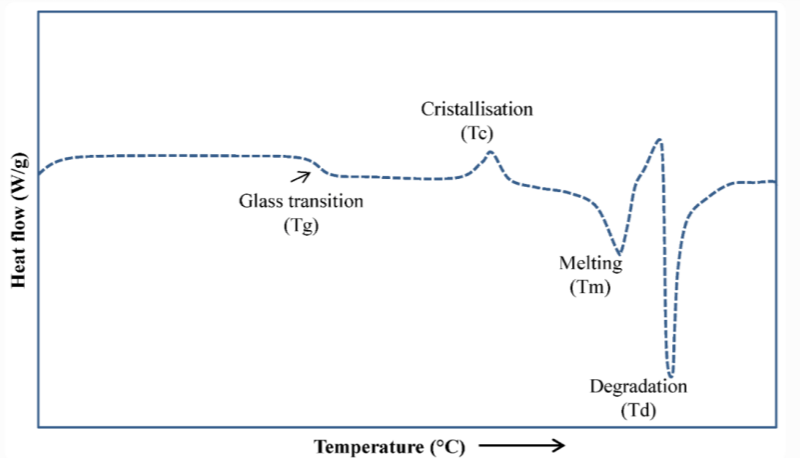
Understanding the thermal behavior of the polymer matrix is fundamental to effective heat treatment. Material suppliers typically provide the following key parameters:
These properties are typically measured using Differential Scanning Calorimetry (DSC), which tracks heat flow as a function of temperature.
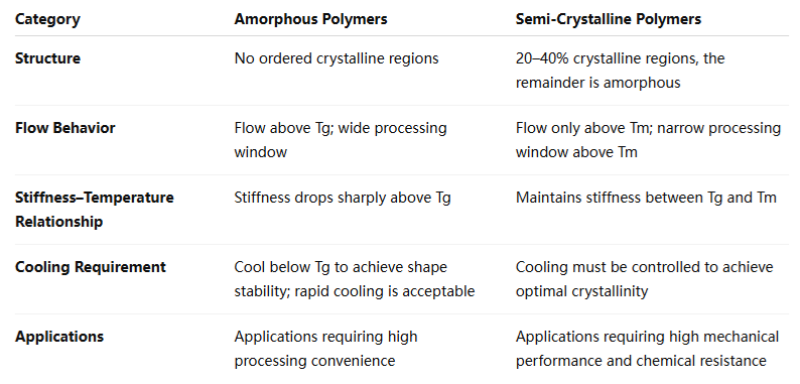
The choice between amorphous and semi-crystalline polymers significantly affects heat treatment requirements.
Amorphous polymers lack an ordered crystalline structure and begin to flow once the temperature exceeds Tg. Their viscosity gradually decreases as temperature increases, providing a relatively wide processing window.
Semi-crystalline polymers typically contain 20–40% crystallinity. Between Tg and Tm they retain stiffness and begin to flow only after reaching Tm, resulting in a narrower processing window but superior high-temperature performance.
During the heating stage, TPCs are brought to the processing temperature (Tp) to achieve sufficiently low viscosity for forming without thermal degradation.
For amorphous polymers the transition occurs at Tg, while for semi-crystalline polymers it occurs at Tm. Product datasheets typically define a recommended processing temperature range.
For high-performance polymers such as the PAEK family, upper temperature limits—often around 400°C—are defined to prevent oxidation during processing.
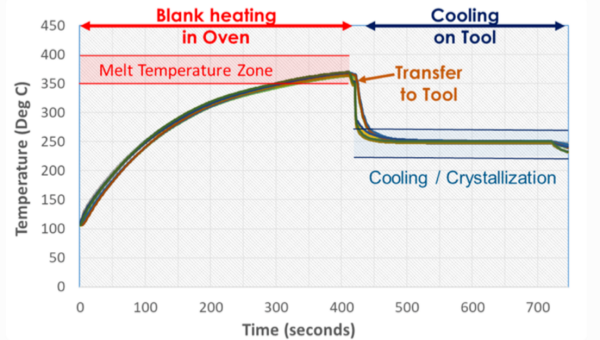
Cooling is the most critical stage for thermoplastic composites, particularly for semi-crystalline polymers, because it determines crystallinity and final performance.
Amorphous TPCs only require cooling below Tg to achieve dimensional stability, allowing very fast production cycles.
Semi-crystalline polymers require controlled cooling within the Tc range to allow nucleation and crystal growth.
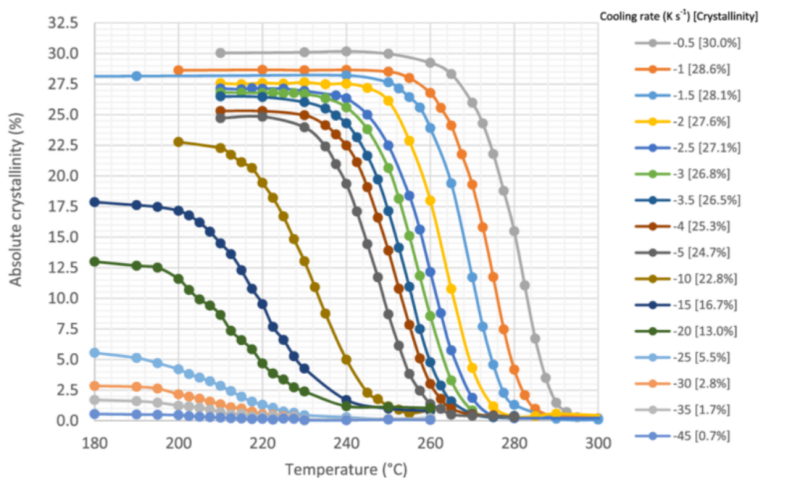
Crystallinity strongly influences environmental resistance and mechanical properties. Optimal crystallinity levels are typically between 20% and 40%.
Higher cooling rates reduce Tc and broaden the crystallization window, but extremely rapid cooling can lead to incomplete crystallization.
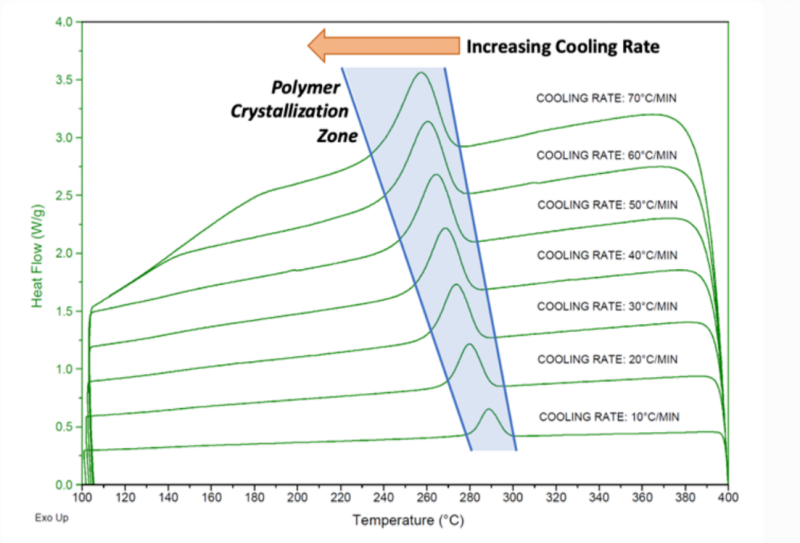
Cooling causes volume changes in semi-crystalline polymers, generating internal stresses. Predictive modeling tools allow engineers to compensate for these effects through optimized mold design.
Thermoplastic composites can withstand multiple thermal cycles such as layup, consolidation, forming, and welding. When properly controlled, high-performance thermoplastics maintain stable mechanical properties even after repeated heating above Tm.
Heat treatment plays a critical role in optimizing thermoplastic composite performance. Cooling controls crystallinity and dimensional stability in semi-crystalline systems, while amorphous polymers enable faster manufacturing cycles.
With proper thermal management, manufacturers can reliably produce high-performance components for demanding industries such as aerospace and automotive.
follow us :


-- get updates with latest topics

 e-mail
 English
 français
 Deutsch
 русский
 italiano
 español
 português
 العربية
 日本語
日本語 한국의
한국의 中文
中文