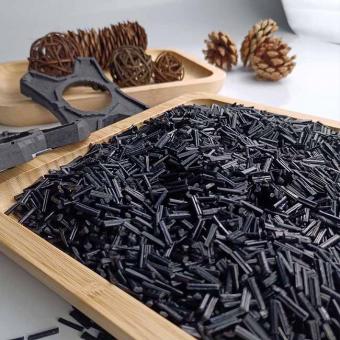

item no.:
PP-NA-LCF30Payment:
T/T or L/C (other payment ways also can be diproduct origin:
Xiamen, ChinaColor:
Original color (also can be customized)shipping port:
Xiamen, ChinaLead Time:
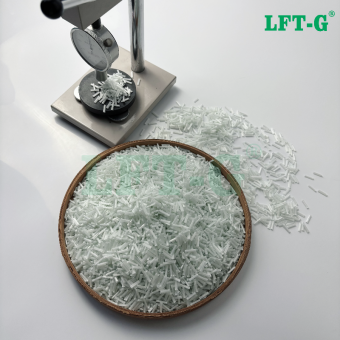
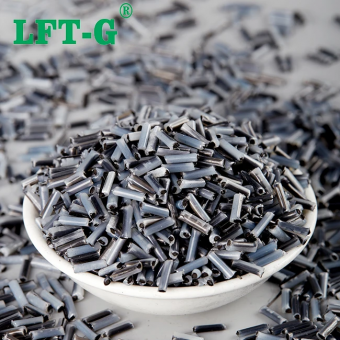
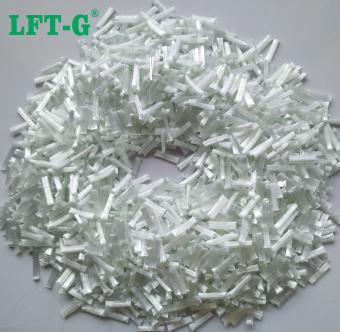
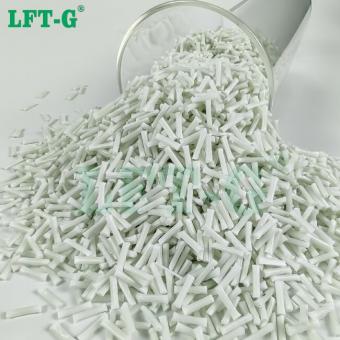
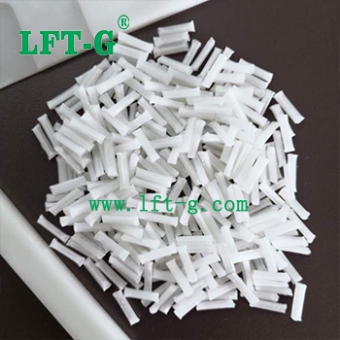
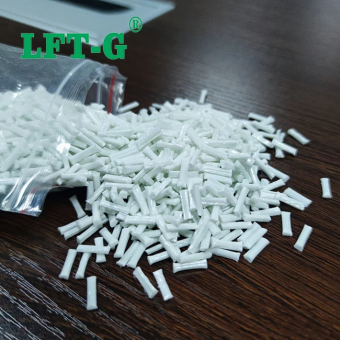
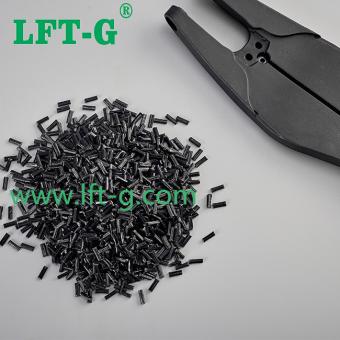
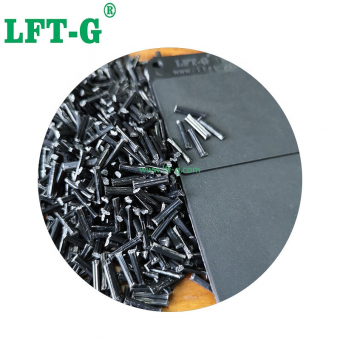
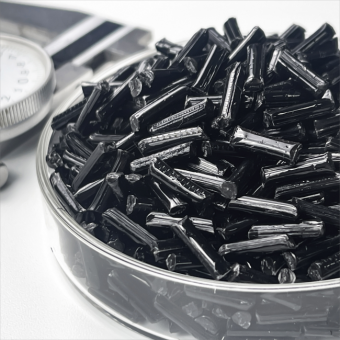
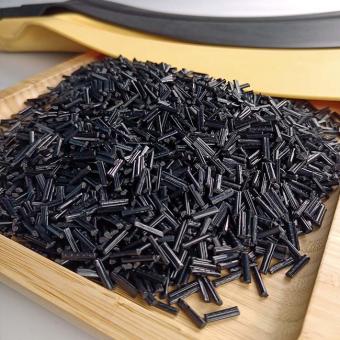
7-15 days after shipmentPP-LCF (Long Carbon Fiber Reinforced Polypropylene) combines the lightweight properties of polypropylene with the high strength and stiffness of long carbon fiber reinforcement. It offers excellent mechanical performance, dimensional stability and weight reduction potential, making it suitable for automotive, industrial and structural applications.
Thermoplastic composites combine a polymer matrix with reinforcing fibers to create materials with enhanced mechanical properties. Their overall performance depends on the resin type, fiber type, fiber content, fiber length and fiber orientation.
Thermoplastic resins such as PP, PA6, PA66, PPA, PPS and PEEK provide the base material, determining chemical resistance, thermal properties and processing characteristics.
Glass fibers and carbon fibers improve mechanical properties, including tensile strength, stiffness and dimensional stability.
Fibers can be arranged as continuous filaments, long fibers, short fibers or woven fabrics. Different structures provide different mechanical performance.
A thermoplastic prepreg is an intermediate composite material produced by impregnating continuous reinforcing fibers or fabrics with a thermoplastic resin. It is commonly supplied in tape or sheet form and used in processes such as thermoforming and automated composite manufacturing.
Note: Thermoplastic prepreg tapes and LFT injection molding pellets are different product forms with different manufacturing processes and applications.
PP-LCF is a long carbon fiber reinforced polypropylene composite. By incorporating long carbon fibers into a polypropylene matrix, the material achieves improved stiffness, strength and structural performance while maintaining the lightweight advantages of PP.

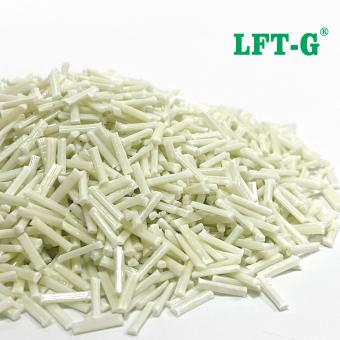
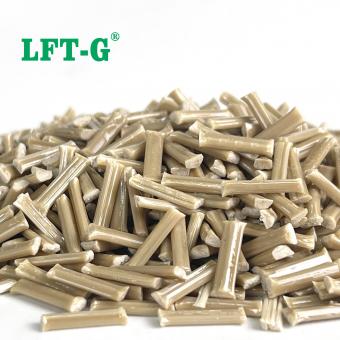
Long Fiber Reinforced Thermoplastics (LFT) are thermoplastic composites reinforced with relatively long fibers. Common matrix resins include PP, PA6, PA66, PBT, PPS and other engineering plastics.
Among these materials, PP-LGF and PP-LCF are widely considered for lightweight structural applications. The choice between glass fiber and carbon fiber depends on the required stiffness, strength, weight, electrical properties and material cost.
Carbon fiber reinforcement provides high specific stiffness and strength, supporting lightweight component design.
Long carbon fibers improve the stiffness of the polypropylene matrix and help support structural applications.
Fiber reinforcement can help reduce shrinkage and warpage, depending on component design and processing conditions.
Long carbon fiber (LCF) and short carbon fiber (SCF) composites differ mainly in fiber length and reinforcement structure. These differences influence mechanical performance, processing behavior and final component properties.
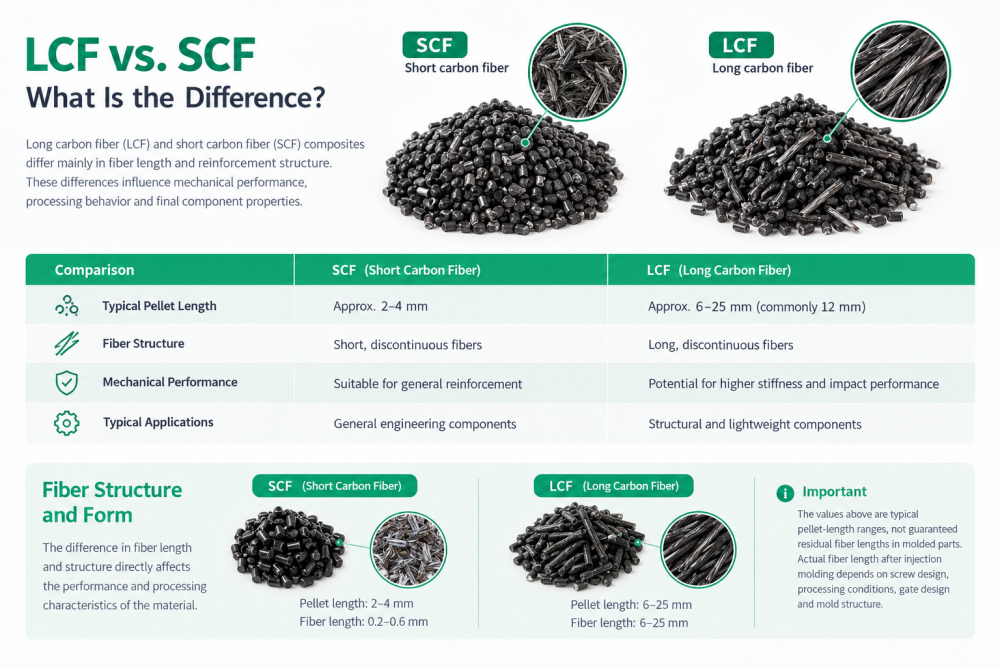
| Comparison | SCF (Short Carbon Fiber) | LCF (Long Carbon Fiber) |
|---|---|---|
| Typical Pellet Length | Approx. 2–4 mm | Approx. 6–25 mm |
| Fiber Structure | Short, discontinuous fibers | Long, discontinuous fibers |
| Mechanical Performance | Suitable for general reinforcement | Potential for higher stiffness and impact performance |
| Typical Applications | General engineering components | Structural and lightweight components |
Important: The values above are typical pellet-length ranges, not guaranteed residual fiber lengths in molded parts. Actual fiber length after injection molding depends on screw design, processing conditions, gate design and mold structure.
LFT materials are widely used in automotive and industrial applications where lightweight construction, mechanical strength and structural reliability are important. PP-LGF and PP-LCF can serve different performance requirements depending on the design.

Replacing PA6-GF30 with PP-LGF50 can be considered in suitable applications after technical evaluation.
Potential benefits include:
01. Lower moisture absorption compared with PA6-based materials.
02. Improved dimensional stability under humid conditions.
03. Reduced sensitivity of mechanical properties to moisture absorption.
Note: Material substitution requires validation of mechanical performance, operating temperature, component design and processing conditions.
LFT-G offers long carbon fiber reinforced thermoplastic compounds based on different polymer matrices to meet diverse mechanical, thermal and application requirements.
A. Yes. Injection molding with long carbon fiber reinforced compounds requires appropriate screw and barrel configurations, nozzle design, gate dimensions and molding parameters. Processing conditions should be optimized to minimize fiber breakage and maintain fiber length in the finished component. Mold design and machine configuration should be evaluated before mass production.
A. Long carbon fiber reinforced thermoplastics offer high specific stiffness, excellent strength-to-weight performance and potential for improved impact resistance. Depending on fiber content and formulation, they can also provide electrical conductivity and electrostatic dissipation. These properties make them attractive alternatives to metal in selected lightweight structural applications.
A. Yes. Thermoplastic composites can generally be recycled through appropriate reprocessing methods. However, repeated processing may reduce fiber length and affect mechanical properties. Recycling methods and the performance of recycled material should be evaluated according to the intended application.
A. PP-LGF is generally a cost-effective choice for applications requiring good stiffness and structural performance. PP-LCF is suitable when higher specific stiffness, lower weight or carbon-fiber-related electrical properties are required. The final selection depends on mechanical requirements, operating conditions, component design and overall project cost.

follow us :


-- get updates with latest topics

 e-mail
 English
 français
 Deutsch
 русский
 italiano
 español
 português
 العربية
 日本語
 한국의
 中文